
2 hr 30 min
Szemlő-hegyi & Pál-völgyi Caves Guided Tour
Descend into Budapest's hidden cave network with expert guides and access restricted underground passages.
Reserve
Hand-picked by our editors — 5 verified cave and underground experiences across Budapest's subterranean network.
Verified partners for every tour, free cancellation where available, and instant confirmation on every booking.
2 hr 30 min
Descend into Budapest's hidden cave network with expert guides and access restricted underground passages.
Reserve
3 hr
Traverse Hungary's most extensive subterranean labyrinth on a thrilling 3-hour climb through limestone passages
Reserve
2 hr 10 min
Venture beneath Castle Hill into a historic labyrinth of natural limestone caverns and centuries-old cellars
ReservePrices from verified partners. Availability updates in real time at checkout. Free cancellation policies apply where shown.
The landmarks, rooms, and views travelers on this tour remember — all visible on a single visit.
Known as the underground flower garden of Budapest, these unique thermal-karst crusts resemble cauliflower clusters.
Famous for its natural acoustics and echo, this chamber is a highlight of the Pál-völgyi system.
Glittering mineral deposits that have formed over millions of years within the Pál-völgyi system.
A fascinating squeeze test exhibit where visitors can learn about caving techniques.
A spacious, high-ceiling passage featuring impressive geological layering and thermal water history.
The natural Buda Hills caves offer a raw geological exploration, whereas the Buda Castle Labyrinth provides a journey through the city's medieval subterranean history. They complement each other; most visitors who do both find the natural formations of a budapest underground cave tour to be the more tranquil experience.
| Feature | Top pick Buda Hills Caves | Castle Labyrinth |
|---|---|---|
Formation Type |
Natural karst system | |
Key Features |
Mineral crystals and stalactites | |
Physical Accessibility |
400 steps access | |
Atmosphere |
Serene and subterranean | |
Primary Experience Type |
Geology and speleology | |
Historic Context |
Late discovery;Centralized medieval cellars | |
| See tickets → |
Verdict: Choose the Buda Hills if you prioritize natural wonders, or select the Castle Labyrinth for a curated look at the historical budapest underground cave tour tours that define local heritage.
Choose your ticket, select your date, and reserve in under two minutes. Secure checkout handled by our verified partner.
Instant confirmation by email, with a mobile voucher you can save offline. No printing, no queuing at a collection desk.
Arrive at the entrance, show your voucher on your phone, and walk in. Most tickets include priority or skip-the-line access.
Practical details for your visit straight from our verified partners — hours, access, rules, and how to get there.
1025 Budapest, Pusztaszeri út 35
Main reception desk
Bus 29 from Kolosy tér to Szemlő-hegyi-barlang; Bus 65 from Kolosy tér to Pál-völgyi cseppkőbarlang.
Sturdy, closed-toe walking shoes with good grip are required for your budapest underground cave tour. The caves maintain a constant temperature around 11–12 °C, so bring a warm layer even during summer months.
Large backpacks and bulky items should be left behind as some passages are narrow. Keep valuables with you at all times during your budapest underground cave tour.
Photography is generally permitted for personal use, but please be mindful of the guide's instructions during your budapest underground cave tour. Avoid using flashes that might disturb the cave's delicate environment.
Szemlő-hegyi Cave offers improved access, but Pál-völgyi Cave is not suitable for individuals with mobility impairments. A budapest underground cave tour involves navigating over 400 steps and uneven terrain.
Mobile phones should be kept on silent during your budapest underground cave tour to respect the cave's natural acoustics. Service may be limited or unavailable underground.
Children must be at least 5 years old and 115 cm tall to participate in a budapest underground cave tour. Younger children are not permitted in Pál-völgyi Cave for safety reasons.
Food and drink are not permitted inside the caves during your budapest underground cave tour. Refreshments can typically be found at the visitor center areas.
Pets are not allowed inside the caves at any time during your budapest underground cave tour. Please make alternative arrangements for your animals.
Ensure you arrive early enough to secure your budapest underground cave tour tickets before the final entry. Tours begin promptly on the hour.
Best time to go, insider tips, nearby landmarks, and the cancellation fine print — flip through to skim what matters to you.
How crowds, weather, and events shift across the year.
Consistent cool temperatures make these caves an ideal escape from the heat, though midday tours can be popular.
Mild weather allows for pleasant walks between the caves and nearby green spaces.
Fewer crowds and comfortable outdoor conditions for exploring the surrounding Buda Hills.
Indoor cave temperature remains constant, providing a stable environment when the city is cold.
Small details that turn a good visit into a great one.
Purchase a combined ticket for 5900 HUF to visit both caves for better value.
Prioritize grip over style, as cave paths can be slippery during a budapest underground cave tour.
Check the official site for audio guide availability if your budapest underground cave tour is not in your native language.
Mid-week morning tours are typically quieter than weekend afternoons.
Always verify your budapest underground cave tour schedule online, especially during public holidays.
Non-bookable sights within a short walk — free to visit, easy to pair.
Scenic hiking trails and viewpoints overlooking the city.
Flexible, no hidden fees.
Full refunds are typically available for cancellations made at least 24 hours in advance. Please refer to your specific booking confirmation for exact provider terms.
Hand-picked options within walking distance — pick a district for vibe, or a specific hotel for convenience.
Area known for quieter, residential atmosphere near the caves.
Szemlő-hegyi Cave was discovered in 1930 during quarry work on Rózsadomb, revealing a labyrinth shaped not by rivers but by ascending thermal water. The cave's pale calcite formations — cauliflower-like clusters called "popcorn" and delicate aragonite needles — formed over two million years as mineral-rich springs rose through fractures in the Triassic limestone. Unlike Hungary's river-carved caves, Szemlő-hegyi belongs to the hydrothermal category, its walls smooth where hot water dissolved the rock rather than abrading it. The cave system remained dry after the thermal activity ceased, preserving fragile structures that would disintegrate in a humid environment. Pál-völgyi Cave, mapped to 31 kilometres, is the longest cave system in Hungary and the second-longest thermal maze cave on Earth. Its passages stack in multiple levels, connected by narrow chimneys and vertical shafts that require metal ladders during guided tours. Exploration continues — surveyors added 1.2 kilometres of new passages in 2019 when a breakthrough connected Pál-völgyi to the neighbouring Mátyás-hegyi system. The cave's temperature holds constant at 11°C year-round, and sections of the tour route pass chambers where nineteenth-century wine cellars were carved into the limestone before the deeper galleries were discovered. Both caves became protected nature reserves in 1982. Szemlő-hegyi gained medical recognition in the 1980s when studies confirmed that its microclimate — stable humidity, low dust, and elevated radon levels — benefits respiratory patients; a dedicated speleotherapy chamber now operates within the cave under clinical supervision. Budapest's underground cave tour routes are maintained by the Duna-Ipoly National Park Directorate, which limits daily visitor numbers to prevent carbon dioxide buildup from breath and body heat. The 400-step descent into Pál-völgyi includes a section called the Radium Hall, named not for radioactivity but for the luminous calcite that early explorers mistook for radium paint. Visitors to the Buda Hills cave system walk through geology that records two distinct epochs: the deposition of marine limestone 220 million years ago when the region lay beneath the Tethys Ocean, and the hydrothermal phase two million years ago when the rising Buda Hills channeled geothermal water upward through fault lines. The caves lie within a 10-kilometre belt of similar formations, though only Szemlő-hegyi and Pál-völgyi are open for public budapest underground cave tour access. The combined ticket offers entry to both sites on the same day, allowing comparison between the therapeutic stillness of Szemlő-hegyi and the vertical athleticism required in Pál-völgyi's deeper passages.
"Szemlő-hegyi Cave was shaped not by rivers but by ascending thermal water, preserving formations that would disintegrate in humidity."
A step-by-step walkthrough of the visit — what you'll see, how long each stage takes, and the details that matter.
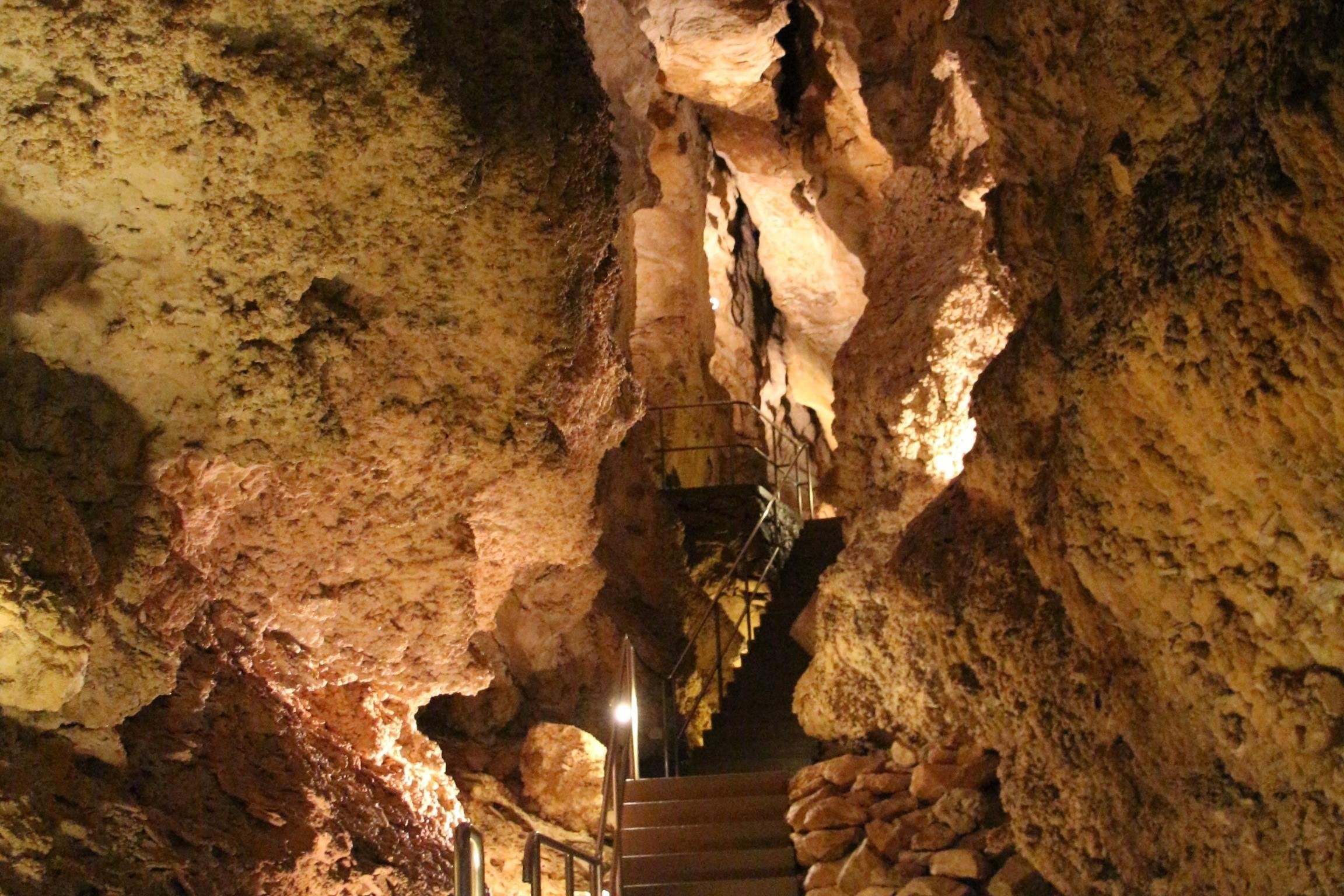
You arrive at Pusztaszeri út 35 for the Szemlő-hegyi tour and pull on the provided fleece jacket — the cave holds 11°C regardless of the summer heat above. Your guide leads the group down a concrete stairway into the first chamber, where overhead lights reveal walls textured like frozen cauliflower. You're looking at popcorn calcite, formed grain by grain as thermal water released dissolved minerals. The air tastes cool and slightly metallic. You walk through a passage called the Crystal Hall, where aragonite needles three centimetres long bristle from the ceiling, and your guide asks the group to pause and breathe slowly so camera flashes won't obscure the delicate structures with dust. At Pál-völgyi Cave on Szépvölgyi út, the route turns vertical. You descend a steel ladder into the Radium Hall, your hands gripping rungs worn smooth by decades of visitors. The guide points out a narrow fissure in the wall — the 2019 breakthrough that connected this cave to Mátyás-hegyi. You climb down 400 steps in total, passing through chambers stacked like floors in a building, each formed when a different fault line channeled thermal water upward. Near the end of the budapest underground cave tour, you pause in a gallery where the walls curve inward, polished smooth by dissolution, and you feel the 220 million years of limestone pressing overhead.
The caves are open Tuesday through Sunday from 10:00 to 16:00, closed on Mondays.
Yes, participants must be at least 5 years old and 115 cm tall for your budapest underground cave tour.
While not always required, booking your budapest underground cave tour tickets in advance is recommended to ensure your preferred time slot.
Yes, photography for personal use is allowed during your budapest underground cave tour.
Wear comfortable, warm clothing and sturdy walking shoes for your budapest underground cave tour.
Szemlő-hegyi Cave has some accessible sections, but Pál-völgyi Cave is not accessible for wheelchairs.
No, food and drink are prohibited inside the cave environment during your budapest underground cave tour.
You can reach the caves via bus 29 or bus 65 from Kolosy tér.
The routes typically include over 400 steps, which is important to consider before starting your budapest underground cave tour.